In 2018, deep in my PhD in sociocultural anthropology, a fellow student and I decided to do something a bit unorthodox for our field: co-write one of our orals documents, the big qualifying papers you have to pass before heading off to fieldwork. These are almost always single-authored. But both of us were interested in collaboration, both wanted to write about it, and what better way was there to write about collaboration than together? Thankfully we had the same advisor, she’s awesome, and she said yes.
There was no template. I still don’t know anyone else who has written a jointly authored orals document, so we figured out the process as we went. We met weekly, sometimes three hours at a time, building a shared set of questions to query the literature. Contrary to what some people assumed, sharing the load did not make it faster. It took much longer. We kept losing each other (“Wait, what do you mean by ethics in your context?”), and it was slow, but the losing made us both clearer.
Then, a week before we were due to meet at our annual conference and write the synthesis together, my colleague had a family emergency and had to step away. I finished alone and submitted a single-authored document. If that emergency had happened in week one, would it have been a collaboration at all, or only an intention to collaborate? Because we had already done so many hours of thinking together, I consider it a successful collaboration, even though my name is the only one on the final document. From the process, I recognized that collaboration isn’t a binary where you either collaborated or you didn’t. It tightens and loosens over time, sometimes on purpose and sometimes because life happens, and one that doesn’t take the shape you intended hasn’t necessarily failed.
I opened with this story in October 2026, when the Open Life Science team invited me to lead a session on collaboration for their Seeds to Systems cohort of open science projects (thank you to OLS for the invitation and for how carefully they hold these cohorts). This post is a write-up of that session and of the questions participants asked afterwards.
What the room assumed
I asked everyone to think of a collaboration that had changed shape and to type into the chat what each side had assumed without ever saying it. The answers had familiar shapes: a collaborator who didn’t deliver on time; partners who quietly abandoned the written plan; an invitation promising full freedom that came with strict hierarchical limits; lives that changed partway through so original commitments could no longer be kept. None of the responses were about bad intentions, for most of them, the trouble came from things nobody had said out loud at the start of a collaborative formation.
One word doing a lot of work
I think part of the problem is the word itself. Anthropologist Emma Cervone asks whether collaboration is too weak a word for everything it’s supposed to hold: complicity, suspicion, commitment, credit, authority. When I went back to my orals research, the same word described very different relationships across the economics, organizational studies, informatics, development studies and anthropology literatures I had read. So I pulled out ten of the meanings I had found (there’s overlap, and there are many more than ten). Collaboration as:
- working side by side
- keeping each other informed
- trading what each side needs
- allying on a shared problem
- dividing up the labor
- thinking together
- blending into one answer
- holding differences open
- sharing credit
- a community setting the terms
I asked participants to type the number that best described a collaboration they were in now, and then the number they thought their collaborator would pick. Almost every number appeared in the chat, and for many people the two numbers didn’t match. No card is right or wrong. But where the numbers differ, expectations about time, credit, data and decision-making probably differ too, and the risk is in assuming from the start that both collaborative partners picked the same one.
Five questions to ask out loud
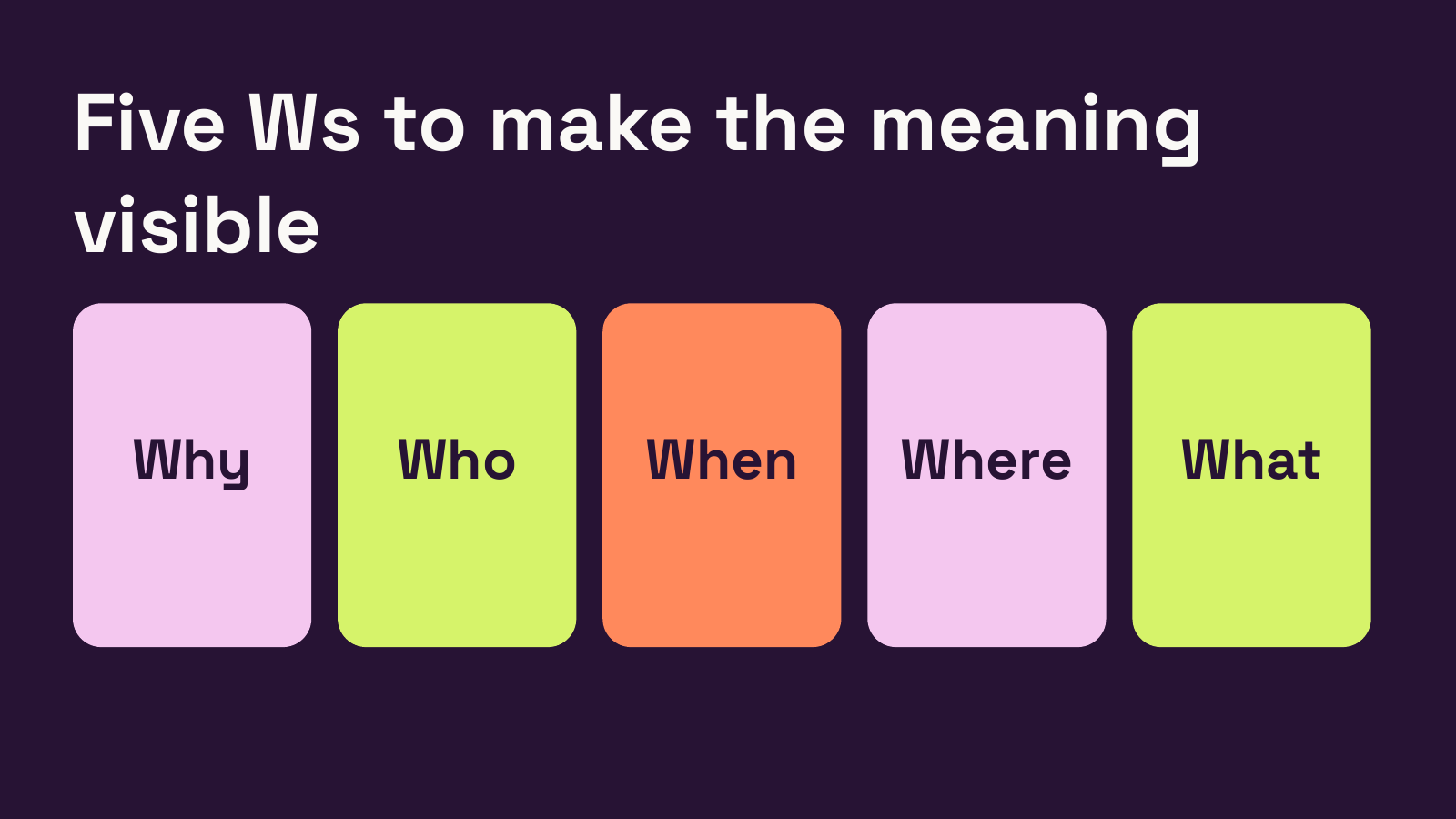
So how do you find out what your collaborators mean? I offered five questions, all beginning with W in the hope that they stick. They are meant to be asked out loud, together, rather than answered alone.
Why are you each in this? Money is often a big one: funders increasingly require partners, or there’s no funding and you need to share costs. Maybe you have a question but not the data, or you need access you can’t get alone. Most of these reasons are strategic, and that’s fine, but name them. The problem isn’t the reason itself; it’s assuming your partner has the same one.
Who is actually collaborating? Name people, not just organizations, because organizations aren’t the ones meeting every week; people are. And name the invisible work: who sets the meetings and takes the notes, is that work named, does it rotate, is it paid? Executive directors sign the paperwork, but they’re often not the ones in the room working it out, so it gets handed down to staff who may or may not have bought in.
When does each kind of collaboration need to happen? In my orals I organized the literature by stage of the research lifecycle to see where people were actually talking about collaboration. Breaking your own project into stages makes the tightening and loosening more intentional. And let me debunk one idea while I’m at it: collaboration usually doesn’t save time. You have to budget for building trust, for coming to agreement on concepts, for making decisions together across time zones. If the timeline already feels tight, add a few extra weeks from the start.
Where does the work pile up? This was the biggest gap I found in my orals research. Even the most thoughtful accounts of collaboration rarely discussed where drafts were kept, where shared datasets lived, who could reuse which data, or how author order was decided. “Where” is also the physical place the work happens: my dissertation was about communities in Nairobi that feel over-researched, places that already feel extracted from. What history are you walking into, and what is your own role in it?
What is the work and what are you each assuming about the work? Write it down, because everything is easier to work through once it’s out in the open instead of sitting as an assumption. During my fieldwork in 2019 I used a research collaboration agreement with my partner organizations (the template is public on Zenodo). It isn’t a perfect document and it isn’t a legal one, but it worked as an object all the partners could point at: this is what the student expects, this is what the organization can expect. There was revision and back and forth, and that was the point. Agreement isn’t the same as consensus. Writing down your differences and agreeing when you’ll revisit them is completely fine.
From the questions afterwards
At the end I put the ten cards back up and asked participants to name not what their collaboration is but what they want it to be. This time I saw more 10s, a community setting the terms. The kind you want can change over time: you might want to think together at the design stage and divide up the labor during data collection.
Participants asked more than we had time for, so I answered several in writing, lightly edited below:
“How do you know whether a collaboration is working?” I’m wary of a single success metric, because “keeping each other informed” and “thinking together” succeed in very different ways. My first check is whether we’re still aligned on the “as” (collaboration as what) and the why. Beyond that: is the invisible work shared or recognized, do disagreements get raised early (silence is often a worse sign than conflict), is credit landing where the work happened, and would we choose to work together again? That last one is the simplest question and often the most honest.
“How can collaborations strengthen local research capacity rather than create dependency?” If that’s the intention, build it into the design. If you’re working somewhere with no one from there on the team, that’s probably a red flag. Ask the people on the ground, ideally before the work plan is finalized and before any funding is involved, because funding always changes the dynamics. Often the experts are already there; they just aren’t as visible.
“Are some groups better set up to collaborate than others?” This question has the answer I most want to end on. I think collaboration is a muscle that needs practice, so people who have been part of different kinds of collaboration find it easier. Values alignment matters too: if you value flat, discussion-based ways of working, it will be hard to collaborate with a group used to working in a very hierarchical, top-down way, and honestly I’d give a team from each tradition trying to collaborate about a 99% chance they won’t have much fun. Naming your assumptions early can weed out formations that aren’t suited to each other.
And sometimes you don’t need to be in a named collaboration at all. You can be in a great relationship with partners without calling it collaboration. It would be wonderful if, after working through these questions, some teams decided not to collaborate. I think that would count as a win.
Acknowledgements and resources
Thank you again to the Open Life Science team for the invitation, and to the cohort participants for their generous stories in the chat. Cassandra Gould van Praag of RCM Cooperative led the second half of the session on community mapping (find her slides here); it was great to learn from her.
Resources mentioned in the session:
- Okune, A. (2019). Research Collaboration Agreement (template). Zenodo.
- Partos. Power Awareness Tool.
- Bartlett, R. (2020). 4 Decision-Making Methods for Decentralised Teams. The Hum.
- Wood, D. J. and Gray, B. (1991). Toward a comprehensive theory of collaboration. The Journal of Applied Behavioral Science 27(2).
- Choy, T. K. et al. (2009). A new form of collaboration in cultural anthropology: Matsutake Worlds. American Ethnologist 36(2).
- Aellah, G., Chantler, T. and Geissler, P. W. (eds) (2016). Global Health Research in an Unequal World: Ethics Case Studies from Africa. CABI.
- Liboiron, M., Zahara, A. and Schoot, I. (2018). Community peer review: a method to bring consent and self-determination into the sciences.
- Cervone, E. (2015). The promises and conundrums of decolonized collaboration. In P. Sillitoe (ed.), Indigenous Studies and Engaged Anthropology.


Leave a Reply